Trusts and Your Estate Plan
How We Help You Build a Complete Estate Plan
We help you create a comprehensive estate plan tailored to your specific needs, goals, and family situation. Our team works closely with you to develop customized solutions, including wills, trusts, powers of attorney, and health care directives.
Estate planning is not just about documents—it’s about protecting your assets, preserving your legacy, and ensuring your loved ones are cared for with clarity and confidence.
Why Your Estate Plan Should Be Personalized
No two families are the same, and your estate plan should reflect that.
We take the time to understand your priorities, your concerns, and your long-term vision. From there, we design a strategy that protects your assets, maintains your privacy, and ensures your wishes are carried out exactly as intended.

What Is Estate Planning and Why Does It Matter?
Estate planning is the process of preparing for how your assets and responsibilities will be managed during your lifetime and after your death.
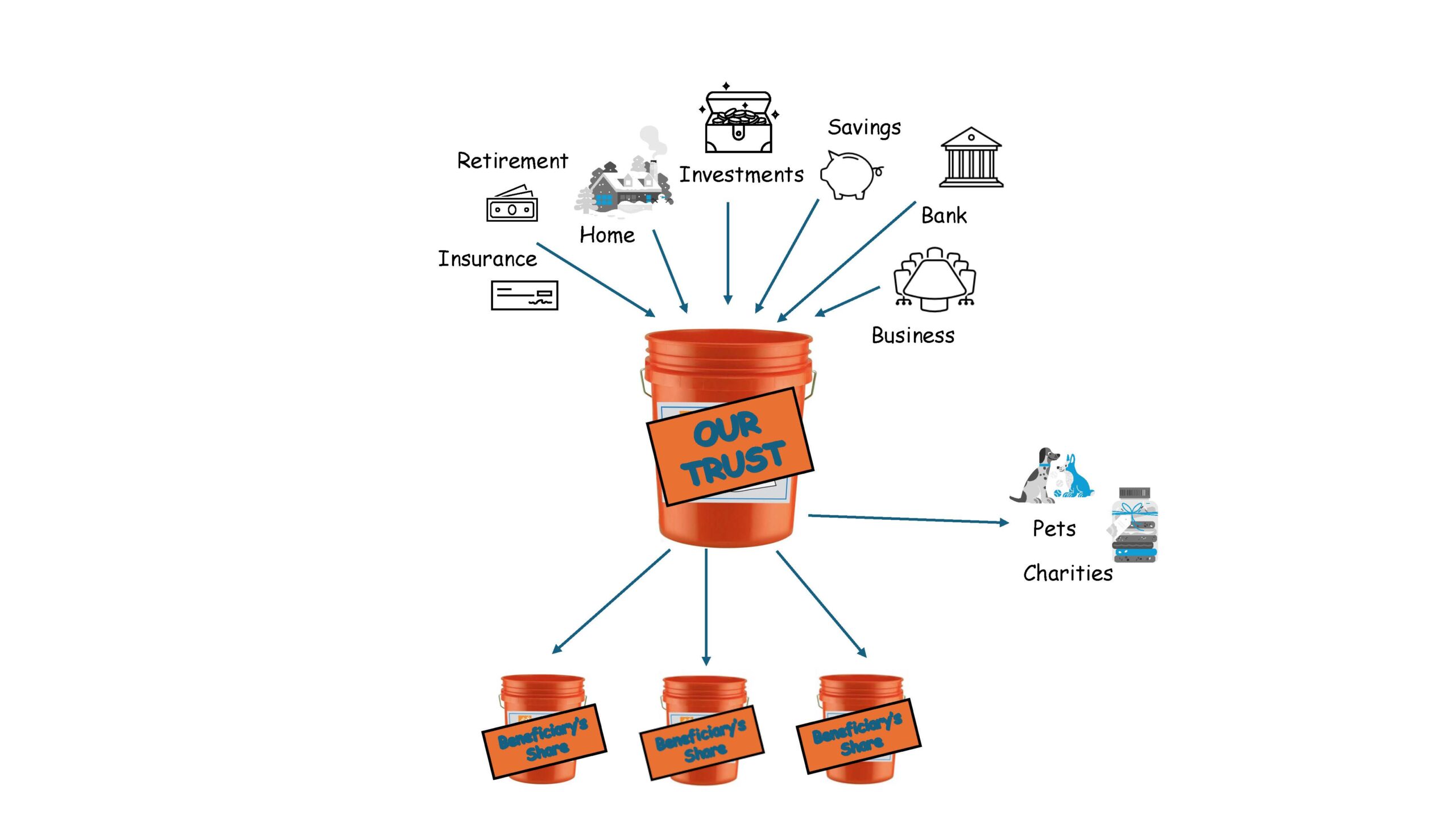
Your estate includes everything you own—your savings, investments, real estate, business interests, personal property, and even provisions for your loved ones and pets.
Without a proper estate plan, the state may decide how your assets are distributed through intestate succession laws, which rarely reflect your true intentions. A well-structured plan ensures that your wishes are honored while minimizing legal complications for your family.
Why Trusts Are Essential in Estate Planning
A trust is one of the most effective tools available to protect your assets and provide clear instructions for the future.
At its core, a trust is a legal arrangement that allows you to place assets into a structured plan—ensuring they are managed and distributed according to your wishes. Think of it as a secure “container” that holds and protects your wealth for your beneficiaries.
Unlike a will, a trust can help avoid the probate process, maintain privacy, and provide greater control over how and when your assets are distributed.
Key Benefits of a Trust
- Avoid Probate: Streamline asset distribution and reduce legal delays
- Maintain Privacy: Keep your financial matters out of public court records
- Protect Beneficiaries: Set conditions to safeguard children or loved ones
- Plan for Incapacity: Ensure your assets are managed if you cannot make decisions
- Minimize Estate Taxes: Preserve more wealth for your family
- Support Special Needs Planning: Protect benefits eligibility for loved ones
- Prepare for Long-Term Care: Help structure assets for Medicaid planning
Are Estate Plans Necessary For Everybody?
Do You Need a Trust or a Will?
A will and a trust serve different but complementary purposes in an estate plan.
A will outlines how your assets should be distributed after your death, but it must go through probate—a public legal process that can be time-consuming and costly.
A trust, on the other hand, allows your assets to bypass probate, offering more privacy, efficiency, and control.
In many cases, the most effective estate plan includes both a will and one or more trusts. An experienced estate planning attorney can help determine the right combination based on your goals.
Types of Trusts We Help You Establish
We design and implement a wide range of trusts to meet different needs and goals, including:
- Revocable Living Trust
- Irrevocable Trust
- Joint Trust
- Spendthrift Trust
- Medicaid Trust
- Special Needs Trust
- Testamentary Trust
- Land Trust
Each type of trust serves a specific purpose, and selecting the right one depends on your financial situation, family structure, and long-term objectives.
When Should You Update Your Estate Plan?
Estate planning is not a one-time event—it should evolve as your life changes.
You should review and update your plan when:
- You get married or divorced
- You have children or grandchildren
- You acquire new assets or a business
- Your financial situation changes
- You move to a new state
Keeping your estate plan up to date ensures it continues to reflect your wishes and protects your family effectively.
Our Proven 5-Step Estate Planning Process
We make the estate planning process simple, clear, and personalized:
- Initial Consultation: We learn about your goals, family, and concerns
- Strategy Development: We design a plan tailored to your needs
- Plan Creation: We prepare all legal documents with precision
- Review & Signing: We guide you through every detail for full clarity
- Ongoing Support: We help you update your plan as life changes
Our goal is not just to create documents, but to give you peace of mind.
Links and Resources

Many clients ask me what will be required of their “Personal Representative” or “Executor” when they pass away; and are concerned about their family members being required to undertake such a responsibility. Here is some information to pass along to their family and to hopefully shed light on the duties required by the position. A…
A durable power of attorney is an extremely important estate planning tool, even more important than a will in many cases. This crucial document allows a person you appoint — your “attorney-in-fact” or “agent” — to act in place of you — the “principal” — for financial purposes when and if you ever become incapacitated…
Having a loved one with dementia can be scary, but if you add in a firearm, it can also get dangerous. To prevent harm to both the individual with dementia and others, it is important to plan ahead for how to deal with any weapons. Research shows that 45 percent of all adults aged 65…
This is the last year that spouses who are turning full retirement age can choose whether to take spousal benefits or to take benefits on their own record. The strategy, used by some couples to maximize their benefits, will not be available to people turning full retirement age after 2019. The claiming strategy — sometimes…
Have you considered your pet or pets when planning your estate? If not, you should, according to The Humane Society of the United States, the nation’s largest animal protection organization. Pets usually have shorter life spans than humans, but people don’t always include their pets in their estate plans. If a pet owner doesn’t make…
The new tax law makes it harder to claim a tax deduction for charitable contributions. While charitable giving should not be only about getting a tax break, if you want to reap a tax benefit from your contributions, there are a couple of options. The Tax Cut and Jobs Act, enacted in December 2017, nearly…
The Social Security Administration has announced a 2.8 percent increase in benefits in 2019, the largest increase since 2012. The change will put an additional $468 annually in the pocket of the average retired beneficiary. Cost of living increases are tied to the consumer price index, and an upturn in inflation rates and gas prices…
Although it is often said that nothing is certain except death and taxes, the one tax you may be able to avoid or minimize most through planning is the tax on capital gains. Here’s what you need to know to do such planning: What is capital gain? Capital gain is the difference between the “basis”…
Once you’ve taken the step to create a will and get your estate plan in order, you need to figure out what to do with the will itself. It is important to keep track of the location of your current will as well as any old wills, and to ensure that your loved ones know…
While the new tax law doubles the federal estate tax exemption, meaning the vast majority of estates will not have to pay any federal estate tax, it doesn’t mean you should ignore its impact on your estate plan. In December 2017, Republicans in Congress and President Trump doubled the federal estate tax exemption to $11.18…
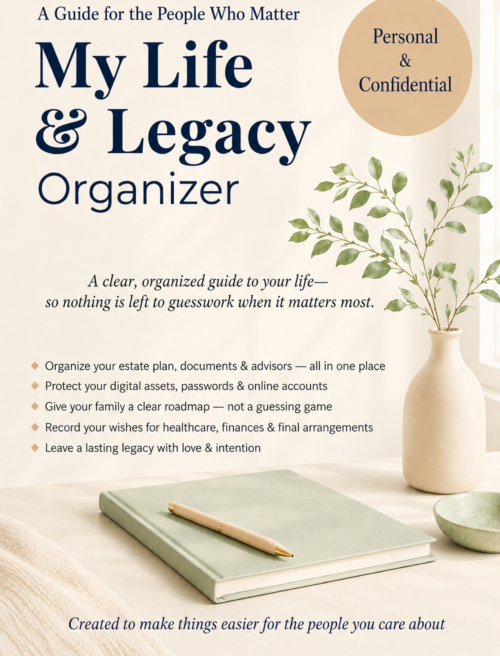
Get The Ultimate Life Organizer
Download the free 17 page version by filling out our form below. For a more detailed planning tool, the full 80-page My Life & Legacy Organizer is available for purchase on Amazon.