What do I do After My Spouse Dies?
Navigating Chaos After a Spouse’s Death
Your estate plan was built around two people. After the loss of a spouse, it needs to be rebuilt around one.
You and your spouse planned a life together.
You may have bought a home, raised children, saved for retirement, named each other in your legal documents, and built an estate plan around the assumption that you would continue making decisions together.
Then suddenly, one person is left to manage everything alone.
Losing a spouse is emotionally overwhelming. During those first days and weeks, paperwork is probably the last thing you want to think about. Unfortunately, banks, insurance companies, government agencies, and court deadlines do not pause while you grieve.
A little preparation—and the right guidance—can make a painful time less chaotic.
The First Steps Can Feel Like a Blur
One of the first things a surviving spouse will need is several certified copies of the death certificate.
Banks, insurance companies, retirement plan administrators, title companies, and government agencies will usually require proof of death before they will release information or transfer assets. It is often helpful to order more copies than you think you will need.
You will also want to locate the original estate planning documents, including:
- The will
- Any trust agreements
- Life insurance policies
- Retirement account information
- Deeds
- Recent bank and investment statements
- Business ownership documents
These records help determine who has authority to act, what assets exist, and whether any court involvement will be required.
Not Everything Passes the Same Way
Many married couples assume that everything automatically belongs to the surviving spouse.
Sometimes that is true. Sometimes it is not.
How an asset passes depends largely on how it is titled and whether a beneficiary has been named.
For example, property owned jointly with rights of survivorship may pass automatically to the surviving owner after the proper paperwork is completed.
Life insurance, retirement accounts, and accounts with payable-on-death or transfer-on-death beneficiaries may also pass directly to the named beneficiary without probate.
However, assets owned in the deceased spouse’s name alone, with no beneficiary designation, may be frozen until a probate court gives someone legal authority to act.
This is why it is important to separate assets into three categories:
- Assets owned jointly
- Assets owned in the deceased spouse’s name alone
- Assets that pass by beneficiary designation
Understanding which category each asset falls into helps determine what can be accessed immediately and what may require additional legal steps.
Probate May—or May Not—Be Necessary
Probate is the court-supervised process of settling an estate.
Not every asset goes through probate, and not every estate requires the same type of court proceeding. The answer depends on what the deceased spouse owned, how those assets were titled, and whether they had named beneficiaries.
A surviving spouse may need probate to:
- Gain access to an individually owned bank account
- Sell or transfer property held in the deceased spouse’s name
- Resolve debts or creditor claims
- Carry out instructions in the will
- Transfer business interests or other assets
In some cases, a simpler process may be available. In others, a formal probate administration may be required.
The sooner the assets and documents are reviewed, the easier it is to determine what steps are actually necessary.
Be Careful About Moving Money Too Quickly
During the first few weeks, surviving spouses are often anxious to combine accounts, close accounts, pay bills, or move money.
Some of those steps may be appropriate, but others should wait until ownership and authority are clear.
For example, a surviving spouse should be cautious about:
- Using funds from an account owned only by the deceased spouse
- Paying personal debts from estate assets without understanding creditor priorities
- Distributing property to family members too early
- Closing accounts before confirming tax and recordkeeping needs
- Selling investments before understanding possible tax consequences
The goal is not to create unnecessary delay. It is to avoid making a decision that later creates legal, financial, or tax problems.
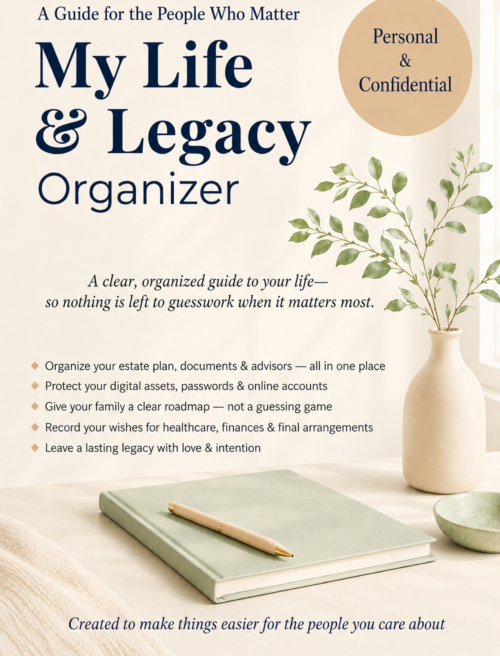
Get The Ultimate Life Organizer
Download the free 21 page version by filling out our form below. For a more detailed planning tool, the full 117-page My Life & Legacy Organizer is available for purchase on Amazon.