Remarried in Florida? What Happens to Your Estate Plan and Your Children’s Inheritance
We all know the story of Cinderella. Her father remarries, dies, and leaves his daughter with a stepmother who has very different ideas about who should benefit from the family money. And the two stepsisters seem to think their main job is making her life miserable.
Recently, a client asked me about something she had heard called a “Cinderella trust.” That is not a real legal term. But take away the glass slipper and the talking mice, and the story is really about a father who did not realize that by getting re-married, he could potentially disinherit his daughter.
In Florida, remarriage can change your estate plan even if you never change a word of your will or trust.
If you remarry and do nothing, three Florida rules can surprise you:
- Your new spouse may receive up to half of your probate estate under an old will.
- Your spouse may have a right to 30% of your broader elective estate, even if you have a trust.
- Your spouse may acquire rights in your Florida homestead that your will or trust cannot simply take away.
If you have children from a prior relationship, those rules can dramatically change what you thought your estate plan would do.
I see a version of this most months. Someone enters a second marriage, leaves the old will or trust exactly as it was, and assumes the children are still covered. This is the one I wish more people knew about before they came to see me. Estate planning for blended families starts with knowing what these rules do to the plan you already have.
An old will signed before the wedding
Say Cinderella’s father signed his will years before he remarried, and it left everything to his daughter. He never updated it after the wedding.
If your will was written before your wedding, there is a rule that will change your well-intentioned wishes.
Florida has a rule for exactly that situation. Lawyers call it the “pretermitted spouse” rule. Essentially, Florida recognizes that your will may have been written before your new spouse was part of the picture.
If you marry after signing your will and die without updating it, your new spouse may be entitled to the same share of your probate estate that he or she would have received if you had died without a will at all.
For example: You sign a will leaving everything to your two children. Five years later, you remarry but never update the will. Even though the will still says “everything to my children,” your new spouse may be entitled to a significant share of the estate. In other words, getting married can change who receives your property even though you never changed a word of your will.
In a blended family, that share is large. When you have children who are not also your new spouse’s children, the spouse’s share under Florida’s intestate succession rules is one-half. It comes out of your probate estate, which is the property that goes through the court-supervised process. So half of what Cinderella’s father left his daughter could go to a stepmother the will never mentions!
The rule does not apply if a prenup or postnup provided for the spouse or gave up this share, if the will provides for the spouse, or if the will shows an intention not to provide for the spouse. A will written before anyone had met the new spouse may do none of those things.
Lesson learned: when you marry, read your will again.
The 30% elective share, even with a trust
Many people set up a revocable living trust for their children, so the property in it never goes through probate. The old-will rule only reaches what passes under the will. The second rule is broader, and a trust does not avoid it.
Believe it or not, it isn’t easy to disinherit your spouse. Florida gives a surviving spouse what is called an elective share. It’s a minimum amount your spouse can claim no matter what your will or trust says, and it is 30% of the elective estate. It is not automatic. Your spouse has to file for it.
Be careful with what counts. The elective estate is much bigger than what goes through probate. Among other things, it counts your home, pay-on-death and transfer-on-death accounts, your share of anything you own jointly, the cash value of life insurance on your life, and retirement accounts.
It also counts a revocable living trust, because you can change it or cancel it right up until you die. So a trust you set up years ago for your children, with nothing in it for a new spouse, is generally part of the elective estate.
That means the plan of leaving everything to the children and nothing to the new spouse may not hold in Florida. You can plan around the 30% once you know it applies. The mistake is writing a plan before anyone adds up what counts.
Florida has a separate rule for the house
This is the closest thing in real life to Cinderella’s actual problem, because it is about the family home. It is also where people get most confused.
I like to tell my clients a story that takes place in the early 1900s when women weren’t allowed to own real property. A husband would go to the local saloon to win back his poker losses, and the only thing left to throw in the pot was the homestead deed. The wife and children would then be left homeless. Therefore, the Florida Constitution has a specific provision that provides extra special homestead protection, and it still decides what happens to your house today.
Under the Florida Constitution, if you are married when you die, you cannot leave your homestead to your children, whether they are grown or not. If there is no minor child, you can leave it to your spouse.
Putting the house in a revocable trust for your children doesn’t get around this. Florida law treats a trust that leaves your house to your children the same as a will that does.
So what happens to the house? Under Florida’s homestead law, a surviving spouse generally receives a life estate, which is the right to live there for life, and your descendants own it after that. Your spouse can instead elect to take a one-half interest in the house, shared with your descendants. That is how it works unless the spouse’s rights have been validly waived or another exception applies.
Either way, your surviving spouse and your adult children end up owning the house together. They share the carrying costs, and they need to agree before anything is sold.
One exception is worth knowing. If the house is owned jointly with a right of survivorship, or by a married couple together as tenants by the entireties, it passes to the surviving co-owner and none of the above happens.

A prenup may change the outcome
I have several ways to remedy this potential disaster. Each of the three rules above can be changed by a written agreement between spouses, and for most couples that agreement is a prenup. We do a lot of prenups in this office.
Florida law lets a spouse give up these rights in a written agreement signed in front of two witnesses, before or after the wedding. That covers the share under an old will, the elective share, and the homestead rights, in whole or in part.
Timing makes a difference. If you sign after the wedding, each spouse has to make a fair disclosure of their finances to the other. A prenup (signed before the wedding) and a postnup (signed after) are not interchangeable in Florida!
A postnup signed without that disclosure is the kind of document that gets challenged at the worst possible moment. Even a prenup can be challenged if one spouse was pressured into signing, misled, or taken unfair advantage of.
If you leave everything outright to your new spouse
Some people react to all of this by going the other way and leaving everything outright to the new spouse. That has its own problem.
Say Cinderella’s father left the house, an investment account, and his bank accounts outright to his new wife. It all became her property, not money she was holding for Cinderella.
The stepmother could spend it. She could give it away. She could even write a new will of her own leaving every dollar to her two daughters! Once she inherits, his will no longer controls any of it. You can completely trust your spouse and still end up here.
The house works the same way. With no minor child, you can leave the homestead to your spouse, and your spouse then owns it outright, not just for life. My trusts and estate planning page answers other common questions about this.
Lesson learned: your children get only what your documents leave them.

A trust can provide for your spouse and still protect your children’s inheritance
Here is where the story could have gone differently. Instead of leaving everything outright, Cinderella’s father could have left it in trust.
The trust can pay his wife income and support for the rest of her life and hold the rest for Cinderella. When the stepmother dies, what remains passes to Cinderella, not to the stepsisters. The trust and the 30% elective share need to be worked through together before the trust is written.
That only works if the trust is written so the surviving spouse has no power to redirect what is left. A trust that gives her a power of appointment (the power to decide who gets what is left) lets her leave the remainder to exactly the people you were planning around.
That arrangement is probably what my client had heard described as a “Cinderella trust.” We lawyers have much duller names for it, but the idea is the same. Your spouse is provided for, and your children still inherit what is left.
The house still follows its own rule, described above, not the terms of the trust.
When the money arrives, and who is in charge of it
Cinderella was young when her father died, and handing a young person everything at once is not always the kindest plan. Her father could have directed a trustee (the person who manages the trust) to pay for her education and housing over time, not to mention real dresses, shoes, and transportation.
If your children are grown, this matters less. If you have a child who is young, has a disability, or is going through a rough stretch, when the money arrives is usually worth more thought than how it is divided.
Who manages the money matters too, and it does not have to be your new spouse. If your spouse is trustee over your children’s inheritance, your children have to ask your spouse every time they need something. That works well in some families. In others, it recreates the exact problem you were trying to prevent. Naming someone else, such as another relative, a trusted friend, or a trust company, avoids that.
What this actually looks like
This isn’t a one-meeting, one-signature errand. In a blended family, the deed, the beneficiary designations on retirement accounts and life insurance, and any marital agreement often control more of an estate than the will does. And not every blended family needs a trust. Some are better served by clean beneficiary designations, a properly titled deed, and a will that says what everyone already expects.
Most blended families have no evil stepmother and no mean stepsisters. But they do involve real relationships and real money. Put your wishes in writing.
If you’ve remarried, or you’re about to, and you have children from before, please don’t leave this on the “back-burner” any longer! The useful next step is a conversation with an estate planning attorney where you look at what you actually own, how it is titled, and what your current will or trust says. If you’re ready to get this done, reach out. I’ll walk you through it.
This article is general information about Florida law as of September 2026, not legal advice, and reading it does not create an attorney client relationship. Statutes change. Every family’s situation is different, and you should speak with a qualified attorney about your own circumstances.
Frequently Asked Questions
These are general answers under Florida law as of September 2026. They are not advice about your own family.
I made my will before I remarried. Is it still good?
Getting married does not cancel it under Florida law, but it may not do what you expect. Under Florida’s pretermitted spouse rule, if the will does not provide for your new spouse and you have children who are not also your spouse’s children, your spouse may receive up to half of your probate estate, unless one of the exceptions described in the article applies. It is worth reading your will again after the wedding.
Can I just leave everything to my children and nothing to my second spouse?
Generally not, in Florida. Your spouse may be able to claim 30% of your elective estate, which includes property in a revocable trust, and you cannot leave your homestead to your children while your spouse survives you. A prenup may change the outcome where both spouses want a different arrangement.
Do stepchildren inherit from me automatically in Florida?
Generally no. Stepchildren you have not legally adopted are not your descendants, so they take nothing under a will that does not name them. If you want to include a stepchild, the document has to say so.
Is a prenuptial agreement enough on its own?
No. A prenup can give up the rights in this article, such as the elective share, the homestead rights, and the share under an old will, but it doesn’t say who gets your property. A will, a trust where one is used, and current beneficiary designations do that.
What about my retirement accounts and life insurance?
These pass by beneficiary designation, not under your will, and they fall into two groups. For IRAs, annuities, life insurance, and payable-on-death accounts, Florida law generally cancels a designation naming a former spouse once the divorce is final, and the asset passes as if the former spouse had died first. Most employer plans, such as a 401(k), follow federal law instead. Federal law generally makes your current spouse the beneficiary unless that spouse has signed a written consent, so an employer plan naming your children may not go to them.
About the Author
Andrea L. Jakob, Esq. is the founder of Andrea L. Jakob, PA, an estate planning, probate, and elder law practice in Davie, Florida, serving families across Broward, Miami-Dade, and Palm Beach Counties and throughout Florida. She writes the monthly “Legally Speaking” column for Our City Media. Her practice areas include wills, trusts, probate, and elder law for Florida families.
Sources
- Art. X, section 4, Florida Constitution, Homestead; exemptions (Florida Legislature)
- Fla. Stat. 732.102, Spouse’s share of intestate estate (Florida Legislature)
- Fla. Stat. 732.2035, Property entering into elective estate (Florida Legislature)
- Fla. Stat. 732.2065, Amount of the elective share (Florida Legislature)
- Fla. Stat. 732.2135, Time of election; extensions; withdrawal (Florida Legislature)
- Fla. Stat. 732.301, Pretermitted spouse (Florida Legislature)
- Fla. Stat. 732.401, Descent of homestead (Florida Legislature)
- Fla. Stat. 732.4015, Devise of homestead (Florida Legislature)
- Fla. Stat. 732.507, Effect of subsequent marriage, birth, adoption, or dissolution of marriage (Florida Legislature)
- Fla. Stat. 732.702, Waiver of spousal rights (Florida Legislature)
- Fla. Stat. 732.703, Effect of divorce on disposition of certain assets at death (Florida Legislature)
- Cinderella’s Father Needed an Estate Plan Too (Andrea Jakob, Our City Media, September 2026)
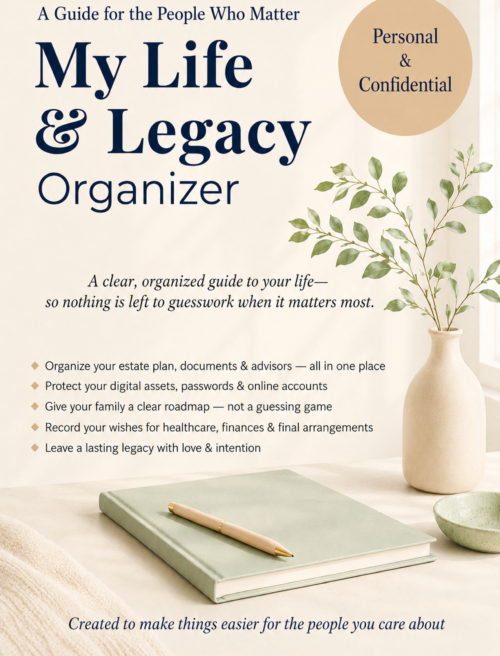
Get The Ultimate Life Organizer
Download the free 21 page version by filling out our form below. For a more detailed planning tool, the full 117-page My Life & Legacy Organizer is available for purchase on Amazon.